
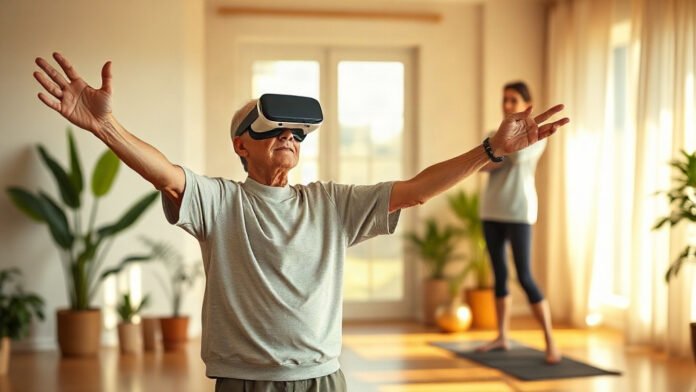
New evidence shows virtual reality training improves both motor control and mood in Parkinson’s patients
KEY STATISTICS
- Virtual reality exercise programs show measurable improvement in motor symptoms like tremor and rigidity
- Psychiatric symptoms including depression and anxiety show clinical improvement with VR-assisted training
- Multiple randomized controlled trials confirm VR exercise effectiveness across diverse Parkinson’s populations
If you or someone you care about is living with Parkinson’s disease, you know that managing symptoms means balancing medications, traditional physical therapy, and lifestyle adjustments. But what if a tool already in many homes—virtual reality—could help you move better and feel better at the same time? New research suggests VR-assisted exercise training may do exactly that, improving both the physical stiffness and slowness that defines Parkinson’s and the depression and anxiety that often accompany it.
How VR exercise works
Virtual reality creates an immersive environment that engages your brain differently than standard exercise. When you move within a VR setting, your brain receives visual and spatial feedback that can help retrain movement patterns and motor control. This multisensory engagement appears to activate neural pathways that benefit people with Parkinson’s in ways traditional workouts sometimes cannot.
- VR provides real-time visual feedback that helps the brain correct movement patterns and improves coordination
- Immersive environments encourage larger, more fluid movements compared to conventional exercise instruction
- Cognitive engagement during VR exercise may enhance neuroplasticity—the brain’s ability to form new neural connections
- Simultaneous physical and mental challenge targets both motor and psychiatric symptoms together
Why midlife adults face this
People in their 40s and beyond are most likely to develop Parkinson’s disease, with risk rising substantially after age 60. However, early-onset cases do occur, and adults in the 35–45 age range may be newly diagnosed or caring for aging parents with the condition. Understanding emerging treatments now can help you advocate for better care options.
- Parkinson’s predominantly affects people over 60, but diagnosis in adults under 50 is increasingly common
- Adults aged 35–45 may be caregivers for aging parents and need evidence-based treatment options
- Earlier disease stages may benefit more from innovative therapies like VR training before symptoms advance
- Mental health complications like depression are common even in early Parkinson’s and respond to active intervention
Watch for these signs
- Tremor in hands or legs, especially at rest or when focusing on other tasks
- Slow, stiff movement or difficulty starting movement (bradykinesia and rigidity)
- Balance problems, shuffling gait, or feeling frozen mid-step
- Depression, anxiety, or mood changes that don’t respond to typical treatment
- Sleep disturbances combined with daytime fatigue or low motivation
- Difficulty with fine motor tasks like writing, buttoning clothes, or holding utensils
Exercise and training that works
VR-assisted exercise works best as part of a broader treatment approach that includes medication, standard physical therapy, and lifestyle support. The evidence shows that structured VR training—not just casual gaming—produces the measurable improvements in motor control and psychiatric symptoms seen in clinical trials. Consistency and proper program design matter.
- Structured VR exercise programs designed for motor rehabilitation show greater benefit than standard exercise alone
- Regular, consistent practice (typically 2–3 sessions per week) produces the best outcomes for motor and mood improvement
- VR training works alongside medications and physical therapy, not as a replacement for medical care
- Tailored programs that target individual movement deficits are more effective than one-size-fits-all approaches
What to do right now
- Ask your neurologist or movement disorder specialist if VR-assisted exercise programs are available in your area
- Research clinical trials or specialized clinics that offer evidence-based VR rehabilitation for Parkinson’s
- If VR isn’t accessible, continue standard physical and occupational therapy while documenting mood changes for your doctor
- Track your motor symptoms (tremor, stiffness, gait) and mood weekly to establish a baseline before starting any new program
- Discuss any new depression, anxiety, or sleep problems with your healthcare provider—these respond well to comprehensive treatment
The mood-movement connection
One often overlooked factor is how isolation and exercise avoidance can worsen both motor and psychiatric symptoms in Parkinson’s. VR training uniquely addresses this because it makes exercise engaging and accessible even when mobility is limited or motivation is low. The cognitive stimulation and sense of progress many people feel in VR environments can lift mood independently of the physical benefits.
- Depression in Parkinson’s is partly driven by inactivity and social isolation—VR engagement combats both
- Achieving visible progress in VR games or movement challenges provides psychological reinforcement and hope
- The novelty and interactivity of VR may boost dopamine function and motivation in ways standard exercise cannot
- Reduced anxiety and improved confidence from VR success can carry over into daily life and social participation
Bottom Line
Virtual reality-assisted exercise training is no longer just a futuristic concept—clinical evidence now shows it genuinely helps people with Parkinson’s disease move better and manage depression and anxiety more effectively. If you’re dealing with Parkinson’s, talking to your neurologist about access to VR programs, or continuing your current therapy while staying alert to new options, is a practical step forward today.
HealthyInsight — always consult a qualified healthcare provider before making changes to your health routine.
Sources
- The Improvement Effects of Virtual Reality-Assisted Exercise Training on Motor and Psychiatric Symptoms in Patients With Parkinson’s Disease: A Meta-Analysis of Randomized Controlled Trials — Actas Españolas de Psiquiatría
- General Parkinson’s Disease Information and Management — National Institute of Neurological Disorders and Stroke (NINDS)
- Depression and Anxiety in Neurological Disease — Mayo Clinic